Last Updated: October 31, 2026
Quick Summary
Choose screen printing for flat, inexpensive large runs with fine detail, and embroidery for textured, durable finishes on structured garments like polos and caps. Design size, order quantity, and fabric type decide which method fits your order.
- Screen printing cost tracks color count and screen setup, which spreads thinner as quantity rises.
- Embroidery cost tracks stitch count, so per-location cost stays roughly constant regardless of quantity.
- Small runs often favor embroidery because there is no multi-screen setup to absorb.
- Structured garments such as polos and caps favor embroidery because the stable surface holds stitching cleanly.
Table of Contents
- Screen Printing and Embroidery at a Glance
- Flat Ink Versus Textured Stitching: What Each Finish Looks Like
- Embroidery vs. Screen Printing Cost: What Drives the Price
- Screen Printing vs. Embroidery Durability After 50 Washes
- Fabric Compatibility: Polyester, Fleece, and Performance Wear
- Design Complexity and Detail Limits for Each Method
- The Best Method for Custom Shirts Depends on Four Questions
- Embroidery for Polos and Hats: Why Stitching Wins on Structured Garments
- Break-Even Order Quantities and Total Cost of Ownership
- Ordering Custom Apparel With Artwork Proofing Built In
- Frequently Asked Questions
Screen Printing and Embroidery at a Glance
Choosing between screen printing and embroidery comes down to one question: does your design need to be flat and inexpensive at volume, or textured and built to outlast the garment? The honest answer is that neither method wins by default. Design size, order quantity, and fabric type decide it.
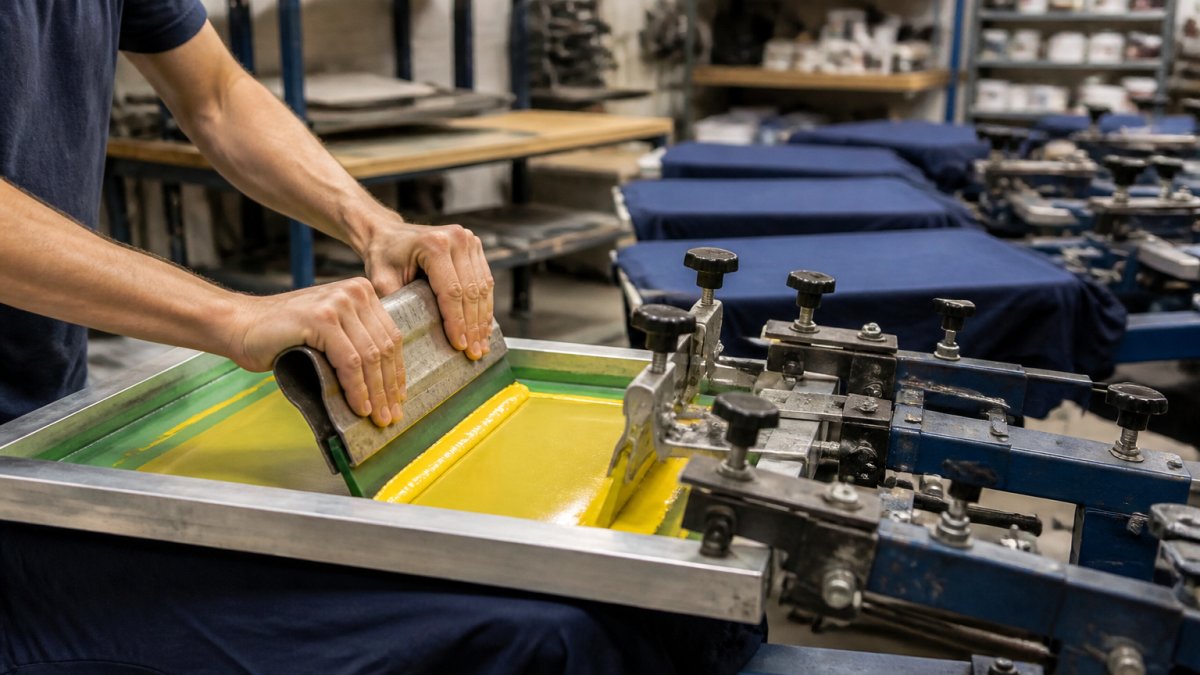
Here is the short version. Screen printing pushes ink through a mesh stencil onto the fabric, producing a smooth, flat finish that scales cheaply across large runs. Embroidery stitches thread directly into the garment, producing a raised, textured finish that holds up for years and reads as premium on structured pieces like polos and caps.
The difference matters most when you are ordering for a group: a 200-piece team order and a 12-piece staff order follow completely different cost logic. Below, we break down how each method works, what drives the price, and how to pick correctly.
Factor | Screen Printing | Embroidery |
|---|---|---|
Finish | Flat ink on fabric | Raised thread texture |
Cost driver | Color count + screens | Stitch count |
Best volume | Large runs | Small to mid runs |
Detail limit | Strokes from 0.0625 in | Strokes from 0.0625 in |
Best garments | Tees, hoodies, performance wear | Polos, caps, fleece |
How Screen Printing Works
Screen printing is a stencil process: a mesh screen is coated with emulsion, your artwork is burned into it, and ink is pushed through the open areas onto the garment. Each color needs its own screen, which is why color count drives both setup time and cost.
The process rewards planning. Bold graphics with solid fills print cleanly and hold their edge wash after wash. Gradients and photographic images require halftone work and tighter registration, which adds production time and risk.
How Embroidery Works
Embroidery is a stitching process: a digitized file tells a multi-needle machine exactly where to lay thread, stitch by stitch. Cost tracks stitch count, which reflects design size and fill density.
Digitizing is the step most buyers underestimate. A logo that looks simple on a business card can require thousands of stitches once it is converted to a sew file, and that conversion is a one-time cost that follows the design, not the order.
Flat Ink Versus Textured Stitching: What Each Finish Looks Like
Screen printing lays ink on the surface of the fabric, so the print sits flat and smooth. Embroidery builds thread above the fabric, so the logo catches light and shows depth. Stand three feet away and you can tell them apart instantly.
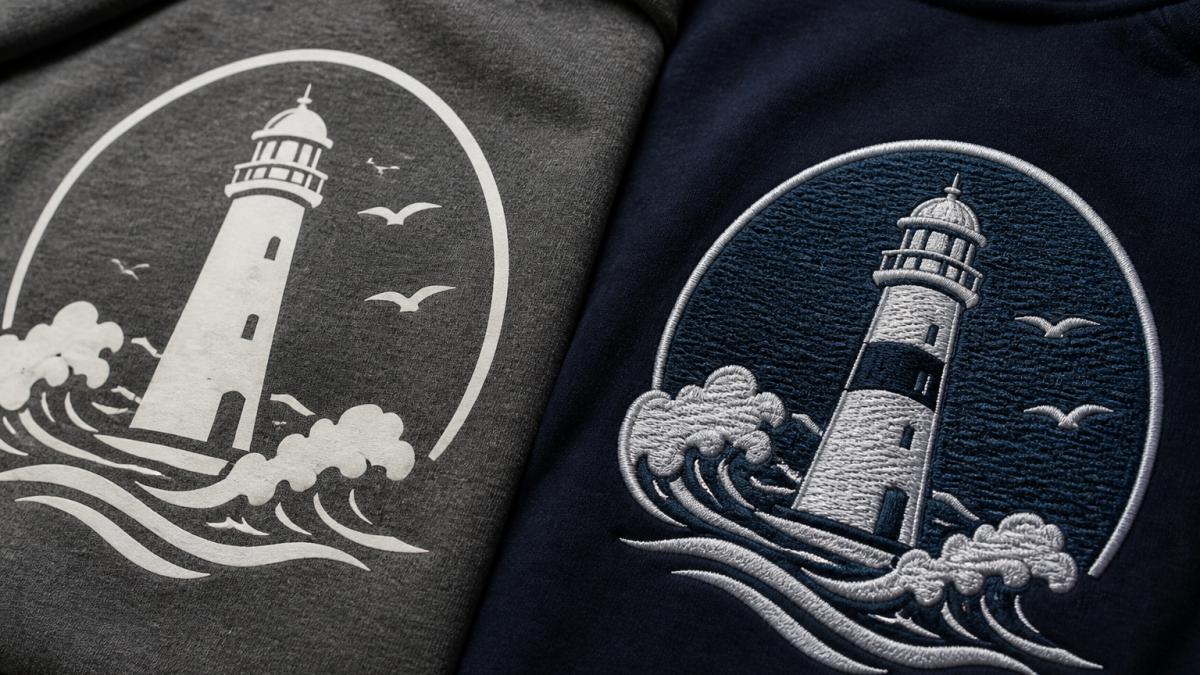
Which look is right depends on the brand you are projecting. A flat finish suits streetwear, event tees, and large back prints where the graphic is the point. A textured finish signals uniform, formal, and corporate: it is the finish people expect on a staff polo or a coach's sideline jacket.
One insider note: a textured finish hides garment imperfections that flat ink will expose. On a heavyweight fleece, embroidery reads as deliberate; a thin ink layer on the same fabric can look washed out before the first wash.
Embroidery vs. Screen Printing Cost: What Drives the Price
Embroidery vs. screen printing cost follows two completely different formulas, and confusing them is the most common quoting mistake we see. Screen printing cost tracks color count and screen setup spread across the run. Embroidery cost tracks stitch count, which reflects design size and fill density.
That means:
- Screen printing: more colors mean more screens, each with its own setup charge. The setup is fixed, so it spreads thinner as quantity rises.
- Embroidery: a bigger, denser logo means more stitches and more machine time per piece. Per-location cost stays roughly constant regardless of quantity.
- Both: garment cost is separate and identical either way.
The practical upshot: a multi-color print carries setup cost that is spread across the run, so it is usually more economical at higher quantities. Pricing depends on quantity, design, and delivery; request a current quote from Streamline Digital Imaging.
Screen Printing vs. Embroidery Durability After 50 Washes
Embroidery is generally regarded as more durable than screen printing over repeated washing, because stitched thread does not fade the way ink can. Screen-printed ink can crack, peel, or fade over repeated washing, especially on thin cotton and when washed hot.
The caveat is print quality. A properly cured print on a quality tee can hold up well over time, while a poorly cured print tends to crack sooner.
Care instructions matter for both:
- Wash inside out in cold water
- Skip the dryer or use low heat
- Avoid ironing directly over ink or thread
For uniforms that get washed weekly, embroidery is the safer bet. For spirit wear worn a few times a season, a good screen print is entirely sufficient.
Fabric Compatibility: Polyester, Fleece, and Performance Wear
Fabric compatibility decides more orders than buyers expect. Screen printing works on many fabrics, though polyester and performance wear generally call for appropriate inks, since dye in synthetic fabric can migrate into the print over time. Cotton and cotton blends are the easiest substrates.
Embroidery can work on polyester, fleece, and performance wear, but fabric weight matters, since lightweight performance fabric can pucker under dense stitching. Heavy fleece and sweatshirts are ideal: they support dense stitching without distortion.
Structured garments are a separate category. Caps and polos hold shape, which makes them natural embroidery candidates. Soft, slinky fabrics fight both methods and should be tested before a full run.
Design Complexity and Detail Limits for Each Method
Design complexity sets a hard ceiling on what each method can reproduce. Per Arklavo's 2026 screen print vs. embroidery comparison, screen printing can reproduce strokes down to 0.2 inches, while embroidery needs strokes of at least 0.5 inches and text at least 1 inch high.
What that means in practice:
- Fine detail, small text, thin lines: screen printing wins. Embroidery will blur or drop anything below its minimums.
- Bold graphics, large fills, simple marks: both work, but embroidery adds texture that suits a premium look.
- Gradients and photographic art: screen printing with halftones, or a digital method. Embroidery cannot reproduce a gradient.
As Printful's embroidery vs. screen printing guide notes, design size and order volume are the two factors that should shape the choice before anything else. If your logo has a tagline in 8-point type, it is a print job, full stop.
The Best Method for Custom Shirts Depends on Four Questions
The best method for custom shirts is not a fixed answer, and a four-question checklist only helps if you know how to weigh the answers. Use the questions below as a scoring pass: each answer points toward one method, and the method that wins the most questions is usually the right call. When the answers split evenly, the tie-breakers at the end decide it.
1. How detailed is the design? Fine text, thin lines, and gradients favor screen printing. As a working rule, text smaller than about 1 inch high or strokes thinner than about 0.5 inch will not survive embroidery's stitch minimums. If your logo includes a tagline in small type, that single answer can settle the decision.
2. What garment is it going on? Structured pieces such as polos and caps favor embroidery because the stable surface holds stitching cleanly. Soft tees and hoodies favor print. Lightweight performance fabric can pucker under dense stitching, so it usually points to print unless the design is small and simple.
3. What is the order quantity? Small runs avoid screen setup costs and often favor embroidery. Large runs reward print's falling per-unit cost. If you expect repeat orders of the same design, remember that digitizing is a one-time cost, which improves embroidery's economics over time.
4. What is the budget and intended lifespan? Uniforms worn weekly justify embroidery's durability and cost per wear. One-event shirts rarely do. If the garment will be washed hard and often, weight durability heavily.
Tie-breakers when the answers conflict:
- If detail and garment disagree (a detailed logo on a polo), test both. A simplified embroidery proof often resolves it, and if the detail cannot be simplified, print wins.
- If quantity and lifespan disagree (a small order of long-life uniforms), lean toward the method with the lower total cost of ownership over the garment's life, not the lower sticker price.
- If budget is the hard constraint, get both methods quoted at your exact quantity before choosing; the cheaper method is not always the one you expect.
A worked example. A 12-piece staff order of polos with a detailed logo: the garment favors embroidery, the small quantity favors embroidery, but the detail favors print. The tie-breaker is to simplify the artwork for stitching and proof it. If the simplified version holds, embroider; if not, print the left chest and accept the flatter look.
Answer all four, apply the tie-breakers, and the method usually picks itself. When it still does not, request samples of both before committing to a full run.
Pro TipScore each question for print or embroidery, then count. A 3-1 split is a clear call; a 2-2 split means the tie-breakers decide, and a sample is the cheapest way to settle it.Embroidery for Polos and Hats: Why Stitching Wins on Structured Garments
Embroidery for polos and hats is close to a settled question in production shops. Structured garments have a stable surface and a curved shape that thread follows naturally, and the textured finish matches the professional look buyers expect from uniform apparel.
Caps are the clearest case. A screen-printed cap logo sits on a curved panel and stretches when worn; an embroidered cap logo holds its shape and reads cleanly from a distance. Polos behave the same way: a left-chest embroidery placement looks intentional and finished, while a small flat print on a collar-adjacent panel can look like an afterthought.
The one limitation is detail. Small text and fine linework will not survive the stitch minimums, so we simplify those elements during artwork review rather than printing something that will not hold.
Break-Even Order Quantities and Total Cost of Ownership
Total cost of ownership flips the usual comparison, and it is the calculation most buyers never run. Screen printing front-loads cost into screen setup and then gets cheaper per garment as quantity rises. Embroidery front-loads cost into digitizing and then holds a steadier per-unit cost because machine time per piece does not fall with volume. The break-even quantity is simply the order size where those two cost curves cross.
To estimate it without a quote, build each side from its components:
- Screen printing total = (screens × setup charge per screen) + (garments × ink cost per piece) + garment cost + finishing.
- Embroidery total = digitizing fee (one-time per design) + (garments × stitch-based machine cost per piece) + garment cost + backing and finishing.
- Shared costs = the blank garment, tagging, folding, and shipping are identical either way, so they cancel out of the comparison.
The variables that move the break-even point:
- Color count. Each additional screen adds a fixed setup charge. A one-color print has a low setup hurdle; a six-color print pushes the break-even quantity much higher.
- Stitch count. A small left-chest logo might run a few thousand stitches; a large back design can run into the tens of thousands. More stitches mean more machine time per piece, which raises embroidery's per-unit cost and lowers the quantity at which print overtakes it.
- Digitizing fee. This is a one-time charge per design, not per order. If you reorder the same logo later, the digitizing cost is already sunk, which improves embroidery's economics on repeat business.
- Order size. Setup charges spread across more units as quantity rises, so print's per-unit cost falls steeply at first and then flattens.
A common pattern practitioners see: on small runs, embroidery often wins because there is no multi-screen setup to absorb; on large runs, screen printing usually wins because setup is spread thin. The crossover typically lands somewhere in the low hundreds of pieces for a multi-color print, but it shifts with every variable above, so treat any single number as a starting estimate, not a rule.
Cost per wear is the second lens. A weekly-worn uniform amortizes embroidery's higher sticker price over hundreds of wears, while a one-event shirt rarely justifies it. When you compare quotes, ask for both methods priced at your actual quantity and color or stitch count, and ask what the reorder price would be once setup and digitizing are already paid.
Key TakeawayThe break-even quantity is not a fixed number. It is the order size where screen setup divided by units equals embroidery's steady per-piece machine cost. Get both methods quoted at your real quantity before deciding.Ordering Custom Apparel With Artwork Proofing Built In
Ordering custom apparel goes wrong at the artwork stage far more often than at production. Files arrive at the wrong resolution, in the wrong color mode, or with detail that will not survive the chosen method. That is why our in-house workflow starts with artwork review and digital proofing before anything touches a screen or a needle.
Since 2009, Streamline Digital Imaging has provided an in-house workflow covering artwork review, digital proofing, and production. For schools, clubs, and businesses ordering in bulk, managed team stores are available for organized ordering and distribution.
If you are weighing methods for an upcoming order, send us the artwork and the garment list. We will proof both options and tell you which one fits. industry guidance on garment decoration methods consistently points to the same conclusion we reach in practice: the design and the garment decide the method, not the other way around.
Frequently Asked Questions
What is the difference between screen printing and embroidery?
Screen printing pushes ink through a mesh screen onto the fabric, creating a flat, smooth design that handles bold graphics and multiple colors well. Embroidery stitches thread directly into the garment, producing a raised, textured finish that holds up on structured items like polos and caps. The practical difference comes down to detail: screen printing can generally reproduce finer detail than embroidery, in general industry comparisons.
Is screen printing or embroidery better for custom shirts?
It depends on the shirt and the design. Screen printing suits high-volume orders with limited colors and large graphics, and it gives a smooth finish on cotton tees and performance wear. Embroidery works better on polos, hats, and heavier garments where a stitched, professional look matters. For large team orders, screen printing often becomes more economical per garment as setup is spread across the run. For small orders such as staff polos with a chest logo, embroidery is often the stronger choice. Pricing depends on quantity, design, and delivery; request a current quote.
Which lasts longer, screen printing or embroidery?
Embroidery generally outlasts screen printing because thread is stitched into the fabric rather than sitting on top of it. Screen-printed ink can fade, crack, or peel over repeated washing, especially on stretchy performance wear or when washed in hot water. Embroidery resists fading and wear and tear far better, though it can snag on rough surfaces. Wash both inside out in cold water and skip the dryer to extend garment lifespan.
Is screen printing or embroidery cheaper for small orders?
Embroidery is often more economical for small orders, because screen printing carries a setup cost for each color that is spread across the run. Embroidery cost generally tracks stitch count, which reflects design size and fill. Pricing depends on quantity, design, and delivery; request a current quote before deciding.
Can you embroider a detailed logo?
Only up to a point. Embroidery needs thicker strokes and larger text than fine print, so fine lines, small type, and gradient shading generally do not reproduce cleanly. A logo with thin script or tiny taglines often needs simplification before it can be stitched. Screen printing is generally the better fit for intricate artwork. If your logo is detail-heavy, ask for an artwork review before committing to embroidery.
What fabrics work best for screen printing and embroidery?
Screen printing bonds well to cotton, cotton blends, and polyester performance wear, and it handles smooth, flat surfaces best. Embroidery needs fabric with enough structure to support stitching without puckering, so polos, caps, fleece, sweatshirts, and heavier woven shirts are ideal. Very thin or stretchy fabrics can distort under dense stitching. Match the method to the garment weight and construction, not just the design, before you place an order.
Most apparel orders go sideways because the method was chosen before the artwork was reviewed. We would rather catch that on a proof than on 300 finished shirts. Streamline Digital Imaging handles artwork cleanup, digital proofing, screen printing, and embroidery in-house, with managed team stores for schools and groups. Get started with Streamline Digital Imaging and order custom apparel that arrives correct the first time.
Order