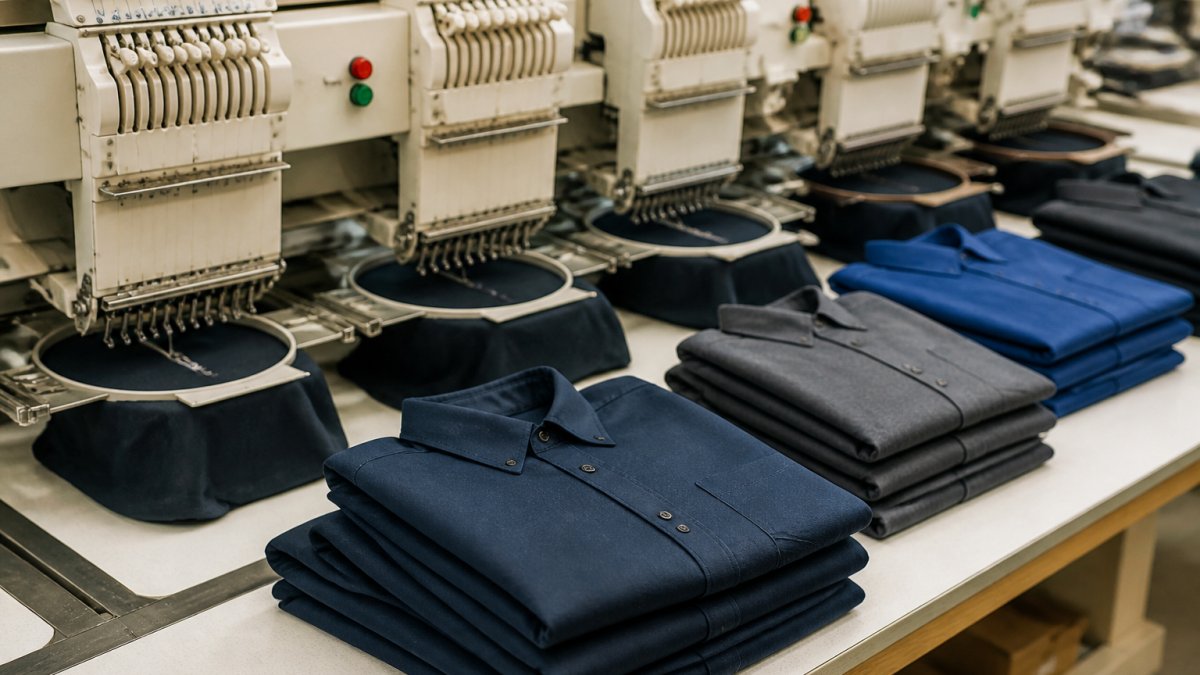
Last Updated: November 1, 2026
Quick Summary
To order embroidered work shirts near you, start by vetting a local provider who embroiders in-house, then choose garments and sizes, prepare your logo file, approve a digital proof, confirm pricing and quantity, set the deadline, and place the order. Ask about minimums, digitizing fees, and fix policies in writing before paying a deposit.
- Ask whether the shop embroiders in-house or brokers the work out, since outsourcing means less control over timing.
- Collect employee sizes early in a shared spreadsheet with name, role, style, size, and quantity.
- Send vector files such as AI, EPS, or PDF, or a PNG at 300 DPI or higher.
- Ask for a sample price at three quantities, such as 12, 48, and 144 pieces.
- Bulk orders of in-stock garments typically take one to two weeks from proof approval.
Table of Contents
- Start With a Local Provider Who Can Prove the Basics
- Choose Your Custom Embroidered Work Shirts and Sizing
- How to Prepare a Logo for Embroidery
- What Drives Work Shirt Embroidery Cost
- Embroidered Work Shirt Turnaround Time and Delivery
- Place Your Order With Streamline Digital Imaging
- Frequently Asked Questions
Start With a Local Provider Who Can Prove the Basics
Ordering embroidered work shirts starts with choosing a provider you can visit, question, and hold accountable. A local shop lets you ask about stitch samples before you commit.
This guide from Streamline Digital Imaging walks through the full process, from vetting a provider to approving a proof to picking up finished shirts.
Here is the short version:
- Vet the provider
- Choose garments and sizes
- Prepare your logo file
- Approve a digital proof
- Confirm pricing and quantity
- Set the deadline
- Place the order
Questions to Ask Before You Commit
Ask these before you pay a deposit:
- Do you embroider in-house, or broker it out? Outsourcing means less control over timing.
- Can I see a stitched sample? A real sample shows thread density and edge sharpness.
- What is your minimum order? Some shops require dozens; others take small runs.
A provider who dodges these questions is telling you something. U.S. Small Business Administration guidance on choosing vendors recommends checking references and getting terms in writing before committing.
Choose Your Custom Embroidered Work Shirts and Sizing
Custom embroidered work shirts should match the job, not just the logo. A polo for front-desk staff is a different garment than a durable button-up for a crew.
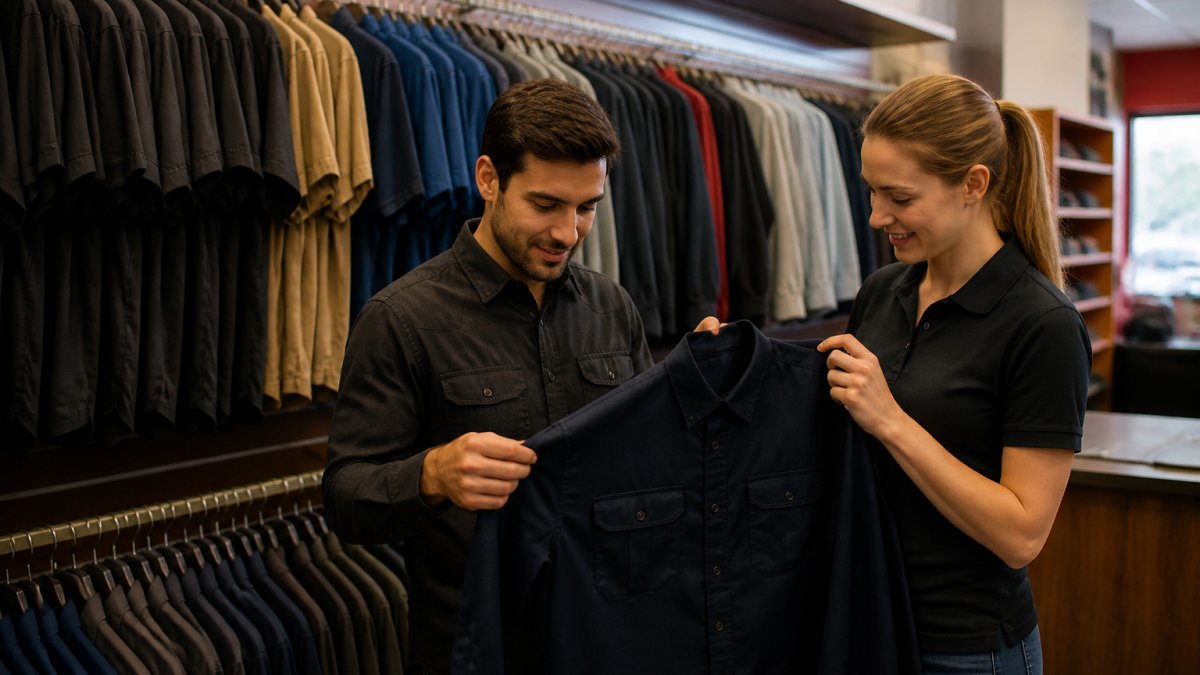
Match the Garment to the Job
Group your team by work type, then choose one or two garments per group rather than one shirt for everyone.
- Office and front-desk staff: A pique polo or soft button-up reads professional and holds a left-chest logo well. Look for a cotton-rich blend that presses cleanly.
- Field crews and trades: A durable poly-cotton button-up resists wrinkles, holds color, and stands up to repeated washing.
- Warehouse and industrial teams: Choose reinforced seams and slightly heavier fabric. Dark colors hide grease and dust.
Fabric Weight, Blend, and Embroidery Behavior
Fabric weight is usually described in ounces per square yard. Midweight fabrics hold embroidery well; very lightweight fabrics can pucker under dense stitching, and very heavy fabrics can dull fine detail.
Blend matters for care and comfort:
- 100% cotton breathes well and takes thread color cleanly, but it wrinkles and can shrink.
- Poly-cotton blends resist wrinkles, hold color, and dry quickly, which suits crews who wash shirts frequently.
- Performance polyester wicks moisture and stretches, but very stretchy fabric needs a stabilizer backing so the logo does not ripple.
Color affects stain visibility and thread contrast. Dark shirts hide stains; light shirts show thread contrast better. Test fine logo detail on the actual shirt color before approving the full run.
Embroidery Placement and Fabric Interaction
Stitch count is the number of stitches in your design. Dense logos on thin fabric can pull and ripple. Tell your provider the fabric before digitizing so they can adjust underlay and stitch density.
Placement also changes the garment choice:
- Left chest is the standard for polos and button-ups and works on most fabric weights.
- Sleeve placement suits performance shirts and keeps the chest clear for name badges.
- Back placement needs a stable fabric panel; stretchy or lightweight backs may need extra backing.
Sizing and Team Ordering Logistics
Collect employee sizes early, and collect them in writing. A shared spreadsheet with name, role, garment style, size, and quantity prevents most order errors.
Practical steps:
- Request a size run sample when possible. Have two or three employees try the actual garment before committing to a full run.
- Order a few extras in the most common sizes. A second run for two missing shirts usually costs more per piece than a small buffer.
- Check the size chart per style. Unisex, women's cut, and performance styles each use different measurements.
- Decide on name personalization early. Individual names add stitching time and change the proofing workflow, so confirm format and spelling before production.
- Plan distribution. For multiple locations, ask whether the provider can bag and label shirts by employee or site.
A common pattern is one shirt style for customer-facing staff and a second, more durable style for field crews. That keeps the brand consistent while giving each group a garment that fits the work.
How to Prepare a Logo for Embroidery
Good artwork saves money and time. Embroidery needs clean, simple shapes, not a photograph.
Prepare your file like this:
- Use vector formats when you have them: AI, EPS, or PDF.
- Send high-resolution raster files if vector is unavailable: PNG at 300 DPI or higher.
- Remove gradients and shadows. Thread cannot blend colors.
Design Submission and Proof Approval
Logo digitizing converts your artwork into a stitch file the machine reads.
After digitizing, you get a digital proof. Check it closely:
- Spelling and letter spacing
- Thread colors against your brand standards
- Embroidery placement on the left chest, sleeve, or back
Approve in writing. A signed proof is your protection if something looks off later.
Watch out: approving a proof without checking spelling is the most common and most expensive mistake in custom embroidery.
What Drives Work Shirt Embroidery Cost
Work shirt embroidery cost depends on several factors, including garment, stitch count, placement, and quantity. Ask for a free quote and a written breakdown so you can compare providers on the same basis.
Ask for a written quote that shows each cost separately.
The Cost Drivers, in Plain Terms
- Garment cost: Blank shirts vary by brand, fabric, and feature set. Ask for the exact brand and style number so you can compare like for like.
- Stitch count: More stitches mean more machine time.
- Placement count: A left chest logo costs less than chest plus sleeve plus back. Each additional placement adds machine time and handling.
How to Compare Quotes
Quotes are hard to compare when providers bundle costs differently. Use a simple normalization method:
- Fix the garment. Ask every provider to quote the same brand, style, and color.
- Fix the decoration. Give each provider the same logo file and the same placement.
- Ask for the all-in per-piece price at your actual quantity, plus the one-time digitizing fee.
- Ask what is not included. Setup, proof revisions, rush fees, and shipping are common add-ons.
Where Orders Quietly Get More Expensive
- Proof revisions after approval. Changes after sign-off may affect cost and timing.
- Size surcharges. Some garments cost more in extended sizes; ask whether the quote includes them.
- Name personalization. Individual names add stitching time and proofing work.
- Split shipments. Multiple delivery locations may add handling or shipping fees.
A written breakdown protects both sides. It shows which line changed if the final invoice differs from the quote, and it gives you a fair basis for comparing a local shop against another provider.
Embroidered Work Shirt Turnaround Time and Delivery
Embroidered work shirt turnaround time depends on factors such as proof approval, garment stock, and order size. Ask your provider for a written production schedule.
Typical timelines:
| Order Type | Typical Window | Clock Starts |
|---|---|---|
| Small run, in-stock garments | A few business days | Proof approval |
| Bulk order, in-stock garments | One to two weeks | Proof approval |
| Special-order garments | Two to four weeks | Garment arrival |
| Rush order | Ask your provider | Confirmed in writing |
Confirm pickup, shipping, and delivery options up front.
Place Your Order With Streamline Digital Imaging
Streamline Digital Imaging handles artwork review, digital proofing, and distribution in-house.
Here is how we would run your order:
- Send your logo and garment preferences
- We review the artwork and flag any embroidery limitations
- You approve a digital proof
- We confirm quantity, sizing, and deadline
- We produce and finish the shirts
- You pick up or arrange delivery
We also set up managed team stores for schools, clubs, and businesses that need organized ordering and distribution across a group.
Best for: schools, businesses, and community groups ordering branded apparel.
Frequently Asked Questions
What file do I need to order embroidered work shirts?
Send a vector file such as EPS, AI, PDF, or SVG so the logo scales cleanly. If you only have a JPG or PNG, ask whether the shop can prepare it for embroidery. Anything with fine text, small gradients, or thin lines may need simplifying before it stitches well. Ask about logo preparation early so you know what cleanup is needed before production starts.
How long does it take to get custom embroidered work shirts?
Embroidered work shirt turnaround time depends on factors such as quantity, garment stock, and how quickly you approve the proof. Ask your provider for a written production schedule before you commit, and confirm whether a rush order is available if you have a hard deadline.
How much is it to have a name embroidered on a shirt?
Work shirt embroidery cost depends on stitch count, thread colors, placement, and quantity. Ask for a quote with your garment, placement, and quantity so pricing is based on your actual job.
Can a local shop embroider shirts I already own?
Ask the shop whether it accepts customer-supplied apparel and confirm it can work with your specific fabric and style. If you are ordering for a team, sourcing blank garments through the shop usually keeps sizing consistent and simplifies order fulfillment.
Ordering embroidered work shirts does not have to be a guessing game. The right local provider shows you samples, explains costs, and puts timelines in writing. Streamline Digital Imaging brings artwork cleanup, digital proofing, in-house embroidery, and organized distribution together so your team gets clean, professional shirts on schedule. Get started with Streamline Digital Imaging and place your first order with confidence.
Order